Objective
This Plan aims to minimize hazards to human health or the environment from fires, explosions, or any unplanned sudden or non-sudden release of hazardous waste or hazardous waste constituents to air, soil, or surface water. The provisions of the plan will be implemented immediately whenever there is a fire, explosion, or release of hazardous waste or hazardous waste constituents which could threaten human health or the environment.
Scope
This plan applies to the Memphis campus of the University of Tennessee Health Science Center (UTHSC). UTHSC departments or sections housed in off-campus facilities should follow the hazardous materials spill contingency plan of their host. This plan is maintained by Campus Safety and Emergency Management and is reviewed annually.
Definitions
Emergency Hazardous Material Spill – Spills of any hazardous material in a quantity or location that the employee has not been trained to handle. These spills are more than about one liter in volume and involve a highly toxic or reactive compound, present an immediate fire or environmental hazard, or require additional PPE (e.g., respirator) and specialized training to properly clean.
Non-Emergency Hazardous Material Spill – Spills involving a material, a quantity and in a location that the employee has been trained to handle and for which the employee has appropriate PPE and spill response materials (e.g., a small spill of a routinely handled chemical reagent on a fume hood benchtop).
Safety Data Sheet (SDS) – Written or printed material concerning a hazardous chemical that is prepared in accordance with the OSHA Hazard Communication Standard (29 CFR 1910.1200). Formerly known as Material Safety Data Sheets (MSDS), an SDS contains information on the potential health effects of exposure to chemicals, or other potentially dangerous substances, and on safe working procedures when handling chemical products.
Roles and Responsibilities
UTHSC Administration shall:
- Designate, in writing, a person to serve as the campus emergency manager to ensure emergency management responsibilities are fulfilled as described in this UT System policy SA0200.
- Ensure the availability of personnel and resources to implement this plan.
Departments directors, principal investigators, and supervisors of personnel that handle hazardous materials and waste shall:
- Ensure that personnel handling hazardous chemicals and waste have access to Safety Data Sheets (SDS) in their work areas.
- Provide chemical spill kits capable of cleaning up non-emergency spills of hazardous materials in areas where hazardous materials are handled.
- Train personnel to properly handle hazardous materials and waste and how to respond in the event of a spill. This training must include the proper use of personal protective equipment (PPE), engineering controls, the use and location of emergency equipment (e.g., emergency eye wash, emergency showers, fire alarm pull stations, fire extinguishers, AEDs, egress routes, etc.) and work practices to minimize the potential for exposure to hazardous chemicals.
UTHSC personnel, including staff and students, who handle hazardous materials and waste shall:
- Comply with procedures for large and small chemical spill response as detailed in this plan and the UTHSC Office of Research Chemical Hygiene Plan.
- Know how to access Safety Data Sheets (SDS) for the hazardous materials in their work areas.
- Maintain chemical spill kits capable of cleaning up non-emergency spills of hazardous materials.
- Contact the spill response team to initiate emergency spill response.
- Perform other assigned duties related to the management of hazardous materials and waste.
Personnel from the Office of Research Safety Affairs and Campus Safety and Emergency Management will constitute the Hazardous Materials Emergency Response Team (HMRT). The HMRT shall:
- Respond to hazardous material spills in an emergency.
- Complete training appropriate for the response to hazardous material spills.
- Coordinate emergency spill response activities with UTHSC departments and other emergency responders.
- Report releases to the appropriate state and federal agencies per 40 CFR Part 355.
UTHSC Campus Police shall:
- Maintain emergency contact information for Research Safety Affairs and Campus Safety and Emergency Management personnel.
- Notify the Safety Office or Hazardous Material Response Team in the event of an emergency hazardous material spill.
The hazardous materials emergency response contractor shall:
- Assist with hazardous material emergencies upon request by authorized UTHSC personnel.
- Manage the transportation and disposal of hazardous chemical waste.
- Comply with federal, state, and local laws related to hazardous material management and emergency response.
The Memphis Fire Department shall:
- Respond to emergency alarms of reports of fire.
- Respond to hazardous material emergencies when incident response requires training and equipment beyond the capabilities of the HMRT.
Training
Members of the HMRT initially receive 40-hours of training in accordance with the Tennessee Occupational Safety and Health Administration Hazardous Waste Operations and Emergency Response Standard (HAZWOPER). Such training includes the following topics:
- Chemical, biological, physical, and radiological hazards
- Risk assessment techniques
- Personal protective equipment
- Control, containment, confinement, and clean-up techniques
- Decontamination
- Basic chemistry and toxicology
Annual hazardous materials emergency response refresher training is provided to the HMRT (ERT). Such training includes the following topics:
- The UTHSC Emergency Response Plan
- Chemical, biological, physical, and radiological hazard awareness
- Notification procedures
Procedure
- General Procedures for Non-Emergency Hazardous Material Spills
Non-emergency hazardous material spills can be cleaned up by properly trained lab personnel familiar with the hazards and handling of the spilled materials. They must use appropriate PPE (e.g., safety glasses/goggles, lab coat, gloves) and a lab spill kit. When a non-emergency spill occurs in the lab, the area around the spill should be isolated, everyone in the lab should be made aware of the spill, and the spilled material should be absorbed and collected using pads or another absorbent. Decontamination of the spill area should be conducted using an appropriate solvent (soap and water is often most effective). Proper PPE shall be worn, and only trained personnel shall conduct the cleanup after reviewing the SDS(s) to obtain chemical-specific cleanup information. Spills of hazardous chemicals must be handled as hazardous waste.
As detailed in the Chemical Hygiene Plan, each laboratory must have a spill response kit available for use. Lab spill kits can either be purchased from a vendor or created by lab personnel, but each spill kit must be equipped to handle small spills of the most common hazards in the laboratory. Spill response and cleanup materials that should be in the kit include:- Absorbent materials such as pads, booms, oil dry or kitty litter
- Neutralizing agents (e.g., Spill X) for acids and/or bases if high volume of acids and/or bases are stored in the laboratory
- Containers such as drums, buckets, and/or bags to containerize spilled material and contaminate debris generated during the cleanup process
- PPE such as gloves, safety glasses and/or goggles, lab coat or apron, chemical-resistant booties
- Caution tape or other means to warn people of the spill
- Emergency Hazardous Material Spill Procedures
Emergency spills are spills of any hazardous material in a quantity or location that the employee has not been trained to handle. Emergency spills are more than about one liter in volume and involve a highly toxic or reactive compound, present an immediate fire or environmental hazard, or require additional PPE (e.g., respirator) and specialized training to properly cleanup. The following procedures must be followed in the event of an emergency hazardous material spill:- Cease all activities and immediately evacuate the affected area (ensure that all personnel in the area are aware of the spill and evacuate).
- If chemical exposure has occurred to the skin or eyes, the affected personnel should be taken to the nearest safety shower and eyewash station.
- Dial (901) 448-4444, to contact the UTHSC Police Department (UTHSC PD). The UTHSC PD will contact the Safety Office to initiate an emergency hazardous material spill response and clean-up. If necessary, the UTHSC PD will be able to contact the appropriate authorities (e.g., fire department, administration, etc.). Callers must provide the following information: name of person reporting, any injuries or exposures, location of the spill (building and room number), type of material(s) and approximate volume spilled, control measures already implemented, controlled access to the spill location until the spill response team arrives. (This can be done by closing doors, posting signs, or otherwise preventing personnel from entering the vicinity of the spill or areas where toxic vapors may be present.)
- Fires or Explosions
In case of a fire or explosion building occupants must take the following steps.- Activate the nearest manual fire alarm.
- If the fire alarm has not sounded, contact Campus Police (901-448-4444) and relay pertinent information.
- Confine the fire and smoke by closing doors and windows, but do not lock doors. Evacuate the building immediately upon the sounding of the fire alarm. Do not use elevators. Proceed to the muster point designated for your building.
- Locate your supervisor or Building Manager for Emergencies immediately and let them know you are out of the building.
- Arrangements with Local Emergency Response Teams and Contractors
UTHSC maintains a contract with EnSafe for hazardous materials emergency response services. The Memphis Fire Department (MFD) maintains emergency plans for response to emergency incidents at UTHSC. The Memphis Fire Department and/or its Hazardous Materials and Rescue Squad may respond to hazardous material emergencies when the incident response requires training and equipment beyond the capabilities of the HMRT. A copy of the UTHSC Emergency Response Plan has been provided to the Memphis-Shelby County Local Emergency Planning Commission to facilitate response efforts. - Notification and Recordkeeping
If the emergency coordinator and Chief Safety Officer determine that UTHSC has had a release, fire, or explosion which could threaten human health, or the environment, outside the facility, the Chief Safety Officer must report the findings as follows:- Immediately notify either the government official designated as the on-scene coordinator for that geographical area or the National Response Center (using their 24-hour toll free number 800-424-8802). The report must include:
Name and telephone number of reporter;
Name and address of the facility;
Time and type of incident (e.g., release, fire);
Name and quantity of material(s) involved, to the extent known;
The extent of injuries, if any; and
The possible hazards to human health, or the environment, outside the facility. - Document the time, date, and details of any incident that requires implementing the contingency plan. Within 15 days after the incident, UTHSC must submit a written report on the incident to the TDEC Commissioner. The report must include:
Name address, and telephone number of the facility; Date, time, and type of incident (e.g., fire, explosion); Name and quantity of material(s) involved;
The extent of injuries, if any;
An assessment of actual or potential hazards to human health or the environment, where this is applicable; and
Estimated quantity and disposition of recovered material that resulted from the incident.
- Immediately notify either the government official designated as the on-scene coordinator for that geographical area or the National Response Center (using their 24-hour toll free number 800-424-8802). The report must include:
Responsible Official
Contact Name | Office Name | Telephone Number | |
Tim Barton, Chief Safety Officer | Campus Safety and Emergency Management | (901) 448-7374 |
Related Policies
UTHSC Emergency Response Plan SA0200: Emergency Management
Attachments
Emergency Contact Information
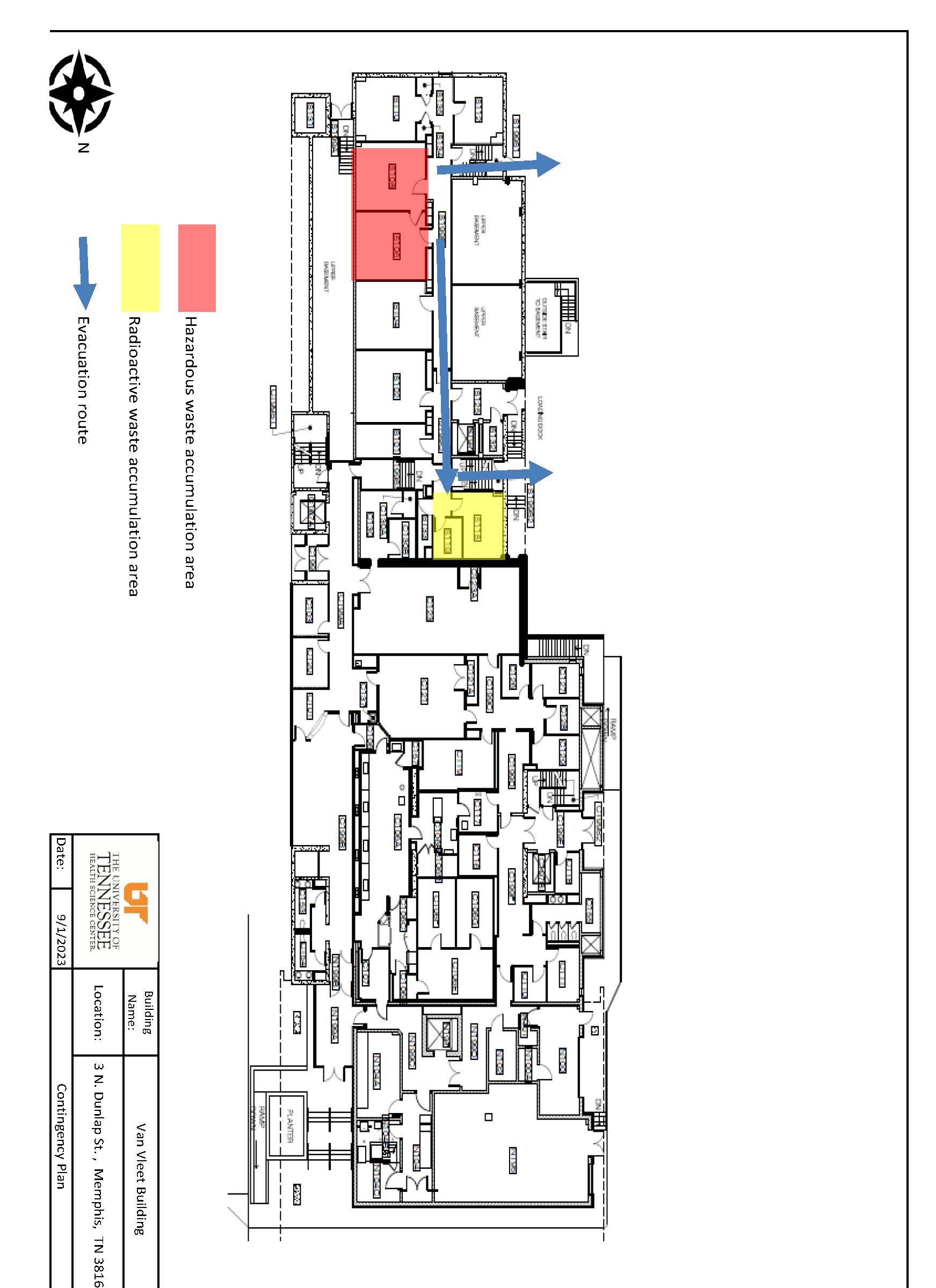
Spill Response Equipment and Materials Hazardous Waste Storage Area Evacuation Plan
UT Health Science Center: HM5207-Hazardous Material Spill Contingency Plan | |
Version 3 | Publication Date: 02/27/2026 |
ATTACHMENT 1
Hazardous Material Spill Contingency Plan Emergency Contact Information
Title: | UTHSC Police (Emergency Coordinator) |
Address: | 3 N Dunlap Street, Memphis, TN 38163 |
Work Phone: | 901-448-4444 |
Title: | Chief Safety Officer |
Name: | Tim Barton |
Address: | 3 N Dunlap Street, Room S206, Memphis, TN 38163 |
Work Phone: | 901-448-7374 |
Mobile Phone: | 901-586-7871 |
Title: | Senior Health and Safety Specialist |
Name: | Mickey Phillips |
Address: | 3 N Dunlap Street, Room S305, Memphis, TN 38163 |
Work Phone: | 901-448-6014 |
Mobile Phone: | 901-481-9801 |
Title: | Environmental (Waste) Coordinator |
Name: | Keith Hoover |
Address: | 3 N Dunlap Street, Room S301, Memphis, TN 38163 |
Work Phone: | 901-448-6115 |
Mobile Phone: | 901-907-2898 |
Title: | Radiation Safety Officer |
Name: | Terry Coggins |
Address: | 3 N Dunlap Street, Room S223, Memphis, TN 38163 |
Work Phone: | 901-448-6114 |
Mobile Phone: | 662-418-8857 |
Title: | Fire Safety Specialist |
Name: | Scott Adams |
Address: | 3 N Dunlap Street, C201, Memphis, TN 38163 |
Work Phone: | 901-448-5619 |
Mobile Phone: | 901-573-6280 |
Title: | Emergency Response Contractor |
Company: | EnSafe |
Contact: | Corey Coleman, 901-482-3742 |
TN Emergency Management: (800) 322-8362
ATTACHMENT 2
Hazardous Material Spill Contingency Plan Emergency Response Supply List
3 North Dunlap Street (Van Vleet Building)
Room S106 & S108
- Spill Kits: Mercury, General Use
- Absorbent pads: Oil, Universal and General Purpose
- Absorbents: Vermiculite
- Heavy duty large black bags, Ziploc bags
- Drums: Various sizes, steel and plastic
- Respirators and Face masks
- Goggles and Safety Glasses
- Nitrile and Neoprene gloves
- Lab Coats
- pH paper
- Peroxide formation paper
- First aid kit
- Brooms, Ladder
- Fire extinguishers
- Fire alarms
- Portable eyewash station
Room S112
- Spill Kits: Acid, Caustic, Solvents, Mercury, Hydrofluoric Acid, Bio-Hazard, Oil
- Absorbent pads: Oil, Universal and General Purpose
- Absorbents: Zorbitol
- Caution tape
- Drums: Various sizes plastic
- Respirators and Face masks
- Face shields
- Goggles and Safety Glasses
- Nitrile and Neoprene gloves
- Tyveks-Yellow and White
- Foot covers
- Flashlights
- Fire extinguishers
- Fire alarms
 Downloadable PDF